
Timed Text Markup Language
The W3C's XML for subtitles and captions, and what broadcasters and streaming services ask for. DFXP was the name of its first profile, and many files still carry it. IMSC, EBU-TT-D and Apple's iTT are TTML too, each with its own habits.
At a glance
| Extension | .ttml |
|---|---|
| Media type | application/ttml+xml |
| Specification | W3C, Timed Text Markup Language 1 (TTML1), a Recommendation. TTML2 extends it; IMSC and EBU-TT-D are subsets for distribution. |
| Time precision | Any: fractions of a second, frames or ticks |
| Text encoding | Declared in the XML. UTF-8 almost always. |
| Styling | Named styles and tts: attributes: font, size, colour, background, italic, bold, underline, line-through, outline |
| Positioning | Regions: boxes placed and sized anywhere on the picture |
| Speakers | Agents (ttm:agent), named in the head |
| In containers | MP4 as stpp (ISO/IEC 14496-30), in DASH, CMAF and HLS streams |
Anatomy of a file
An XML document: a head that names styles and regions, and a body of paragraphs, one for each subtitle.
<tt xml:lang="en" …>
<head>styles, regions</head>
<body><div>
<p begin="00:00:23.000"
   end="00:00:24.500">
You're a jerk,<br/>Thom.</p>
</div></body>
</tt>
- 1 · Root
<tt>, with TTML's namespaces, the language, and the clock the times count by:ttp:frameRate,ttp:tickRate. - 2 · Head
Named styles, the regions of the screen, and who speaks.
- 3 · Timing
Each paragraph's
begin, and itsendordur. - 4 · Text
The subtitle. Spans style parts of it, and
<br/>breaks the line.
Times
TTML writes a time in more ways than any other subtitle format:
| Written | What it is |
|---|---|
00:00:23.500 |
Hours, minutes, seconds and a fraction |
00:00:23:12 |
Frames after the seconds: twelve at the file's ttp:frameRate |
23.5s, 23500ms, 1h |
An offset in hours, minutes, seconds or milliseconds |
564f |
Frames |
235000000t |
Ticks, ttp:tickRate of them to the second |
Times count from what holds them. A paragraph's begin counts from the start of its <div> and its <body>, and a paragraph with no end of its own ends with them.
Styles
A style is a set of tts: attributes. Text takes them in order: from its region, then from the body, div, paragraph and span around it. Each element takes the styles it names (style="s1 s2", and the ones those name), then its own attributes.
| Attribute | Effect | In Subtitld |
|---|---|---|
tts:fontStyle="italic" |
Italic | Kept |
tts:fontWeight="bold" |
Bold | Kept |
tts:textDecoration="underline", "lineThrough" |
Underline, strikeout | Kept |
tts:color |
Text colour: a name, #rrggbb, #rrggbbaa or rgb() |
Kept, without its transparency |
tts:displayAlign, tts:textAlign |
Where the text sits in its region | Kept, as one of nine places |
tts:fontFamily, tts:fontSize |
Font and size | Not kept |
tts:backgroundColor, tts:textOutline |
A box behind the text, an outline | Not kept |
<set> |
A style that changes over time | Not kept |
Regions
A region is a box on the picture, placed by tts:origin and sized by tts:extent. Inside it, tts:displayAlign puts the text at the top, middle or bottom (before, center, after), and tts:textAlign to one side or in the centre.
<region xml:id="top"
        tts:origin="10% 10%"
        tts:extent="80% 80%"
        tts:displayAlign="before"/>
Subtitld works out where the text lands, whether the region is measured in percentages, pixels or cells, and takes the nearest of the nine places that SubRip's {\an1} to {\an9} name. When it writes a file, each place it uses is a region of that name: bottom, top, top-left…
When a file does not say. TTML's own defaults put text at the top left of its region, but players show it at the bottom and centred, and so does Subtitld. It also reads textAlign="start" in a region with no size or place as centred: files written with pycaption, older Subtitld's among them, put it on every region.
Profiles
Most TTML is written to a profile: a subset of the language, with rules of its own. Subtitld reads each of them as TTML.
| Profile | Where it is used | Its habits |
|---|---|---|
| DFXP | TTML's first profile, and the extension .dfxp |
Older files in the namespace http://www.w3.org/2006/10/ttaf1 |
| IMSC 1 | Streaming over DASH, CMAF and HLS | The W3C's profile for subtitles and captions online |
| EBU‑TT‑D | European broadcasters' online players | Elements often written with a prefix: <tt:p> |
| SMPTE‑TT | American television's captions online | SMPTE's additions, for captions carried over from broadcast |
iTT (.itt) |
Deliveries to Apple's iTunes Store and Apple TV | Times in frames (ttp:timeBase="smpte") |
TTML in Subtitld
- Every subtitle's text and line breaks
- Italic, bold, underline, strikeout and colour
- Where it sits on the screen
- Speakers, as agents
- Start and end, to the millisecond, in order
- Fonts, sizes, backgrounds and outlines line by line
- A region's exact size and place
- Styles that change over time, ruby, image subtitles
- Translations beside the original, dubs, speakers' faces
Save a .usfx project to keep what is Subtitld's.
Opening a TTML file
Subtitld opens .ttml, .dfxp, .itt and .xml, and:
- reads TTML however it is written: in its namespace, in the old DFXP one, or with
tt:before every element; - reads every form of time, each counted from the div and body it is in;
- follows styles as TTML applies them, keeping italic, bold, underline, strikeout and any colour other than white;
- puts each subtitle where its region shows it;
- takes agents as speakers, ready for dubbing, and the file's
xml:langas the project's language; - reads the encoding the file declares, and HTML's entities such as
.
A file that is not well-formed XML opens with a message giving the line and the column. A file that is not TTML at all says so.
Exporting TTML
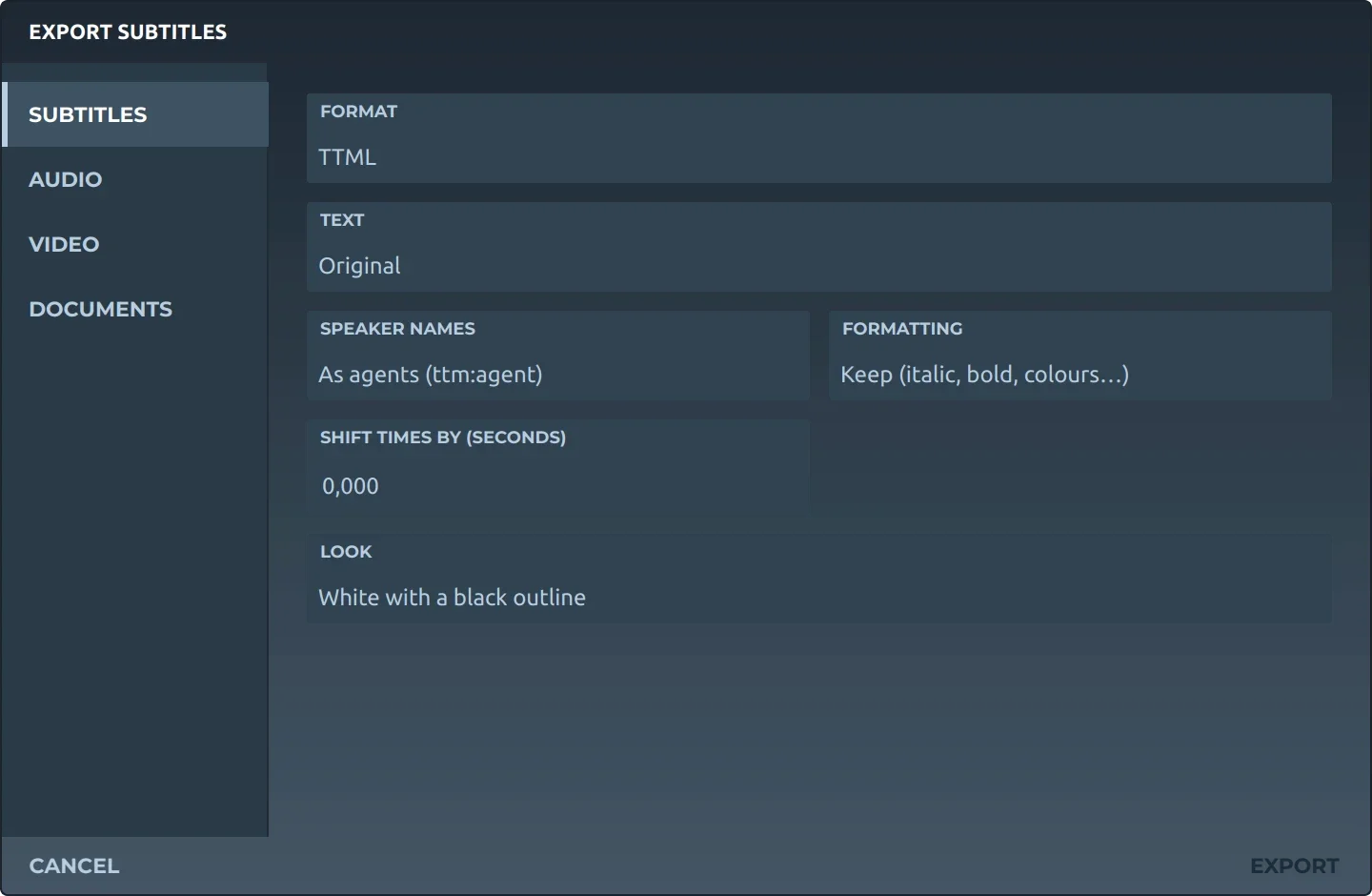
Export, then Subtitles and TTML or DFXP, offers:
- TextThe original, a translation, or both, the translation below.
- Speaker namesLeft out, before the text (Thom: …), or as agents (
ttm:agent), TTML's own way. - FormattingKept, or removed.
- Shift timesEvery subtitle earlier or later by the same amount.
- LookWhite with a black outline, or as Subtitld's preview draws it: its font, colour and translucent box.
The file is TTML 1 in UTF-8. Times are written as 00:00:23.000, each place the subtitles sit as a region, formatting as spans, and line breaks as <br/>. Its xml:lang is the language of the text it holds. TTML and DFXP get the same file; only the extension differs.
TTML or WebVTT?
WebVTT for a <track> on a web page: browsers read it themselves. TTML for broadcasters, for streaming services that ask for it, and for players that read it, such as dash.js and Shaka Player. The WebVTT page has the rest.
Trivia
TTML 1.0 became a W3C Recommendation in November 2010, after drafts named for its first profile: the Distribution Format Exchange Profile, DFXP.
The old namespace, http://www.w3.org/2006/10/ttaf1, is from the 2006 drafts, when TTML was the Timed Text Authoring Format. Files still carry it.
In 2016 the W3C received a Technology & Engineering Emmy for TTML, beside HBO, Netflix, Telestream and SMPTE.
Related formats
Open it in Subtitld with the video and retime it on the waveform.